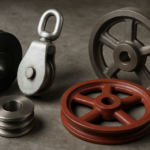
Sheave Design and Engineering
Why it matters
Sheaves are critical components in lifting and rigging systems. Proper design ensures safety, efficiency, and longevity of equipment. Mistakes in sheave engineering can lead to premature failure and costly downtime.
Load capacity calculations
Calculating load capacity is the foundation of sheave design. Engineers must consider the maximum expected load and dynamic forces during operation. Overestimating capacity leads to unnecessary weight and cost, while underestimating it risks catastrophic failure.
Load capacity depends on material strength, bearing type, and rope interaction. Ignoring these factors can cause excessive wear or deformation. Accurate calculations also account for safety factors and potential shock loads to prevent unexpected breakdowns.
The best sheave manufacturers, like Bear Equipment from Louisiana, pride themselves on well engineered durable sheaves that can be custom designed for just about any application.
Sheave diameter and rope compatibility
The sheave diameter directly affects rope life and performance. If the diameter is too small relative to the rope, it causes excessive bending stress and accelerates wear. Conversely, a very large diameter may increase system size and weight unnecessarily.
Choosing the right diameter involves balancing rope diameter, rope construction, and operational conditions. Designers must also consider the groove profile to ensure proper rope seating without crushing or slipping. This tradeoff impacts both safety and maintenance intervals.
Stress analysis in sheave design
Stress analysis identifies critical points where the sheave may fail under load. Common failure modes include groove cracking, shaft bending, and bearing wear. Engineers use finite element analysis to predict stress distribution and optimize geometry.
Ignoring stress concentrations can lead to fatigue failure, especially in cyclic loading environments. Proper stress management extends service life and reduces the risk of sudden breakdowns. This step is essential for both standard and custom sheave designs.
Custom sheave manufacturing
For detailed guidance on these design considerations, the sheave design manual offers comprehensive technical insights.
Custom sheaves address unique operational demands that standard models cannot meet. Manufacturing custom sheaves requires precise machining and material selection to handle specific loads and environmental conditions. However, custom designs often face challenges such as longer lead times and higher costs.
Sheave balancing and vibration reduction
Designers must balance customization benefits against these constraints. For example, selecting appropriate alloys and surface treatments can improve durability but may increase complexity. This decision impacts both performance and budget.
Imbalance in sheaves causes vibration, leading to accelerated wear and noise. Balancing the sheave is critical to maintain smooth operation, especially at high speeds. Engineers must consider mass distribution and dynamic forces during rotation.
Improper balancing can cause bearing damage and reduce system reliability. Techniques like precision machining and dynamic balancing help minimize vibrations. This attention to detail improves equipment lifespan and operator safety.
Integrating design fundamentals and practical constraints
Understanding the sheave design basics helps engineers avoid common pitfalls and optimize their designs for real-world applications.
Successful sheave engineering requires integrating load calculations, material properties, and operational factors. Designers must also consider maintenance accessibility and cost-effectiveness. Overlooking any aspect can compromise system performance.
Final considerations
Sheave design is a complex balance of mechanical principles and practical constraints. Each decision affects safety, durability, and cost. Careful engineering and thorough analysis prevent failures and extend equipment life.